Often referred to as “top surgery,” MTF breast augmentation is an important step in gender confirmation. It can also offer relief from dysphoria by creating a more feminine appearance.
Gender-affirming breast augmentation is quite different from, and significantly more complex than, the breast implants offered by most clinics — anatomy, body size, and shape all differ, so a specialist is essential. Our surgeons draw on specialized training, an artistic eye, and experience across thousands of these procedures to help you achieve your goals.
An important consideration beforehand: patients should be on Hormone Replacement Therapy (HRT) for at least one year. It is very rare for HRT alone to produce the breast size and shape most patients want for gender confirmation, which is why surgery is usually needed.

A specialized technique and extensive surgical experience are used to balance both sides evenly. The nipple and areola are adjusted to balance shape, size, and position relative to the shoulders.

The 3 Incision Locations
- Periareolar incision – around the nipple.
- Transaxillary incision – in the armpit.
- Inframammary incision – in the crease under the breast.
The choice depends on several factors, including how much enlargement the patient wants, their anatomy, the type of implant chosen, and the surgical plan. We always aim for the least invasive approach and to minimize scarring.
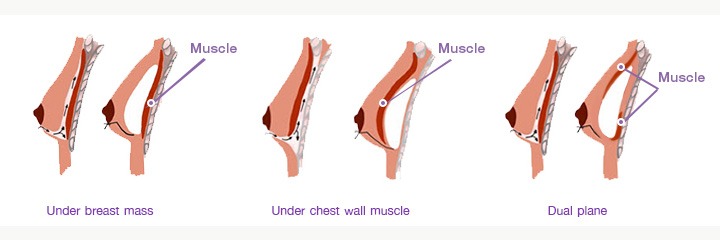
Implant Positioning
- The implant is under breast mass.
- The implant is under the chest wall muscle.
- The implant is a Dual Plane, a combination of breast mass and muscle.
A Good Candidate
- Has been on hormones for at least one year before surgery.
- In good health.
- Has realistic expectations.
- Aged over 18.
Preparation
- Consult with the surgeon to choose the most suitable option for your goals and anatomy.
- Undergo a physical examination to confirm there are no health conditions that could affect surgery.
- Stop medications that interfere with blood clotting — such as aspirin, ibuprofen, and some vitamins and herbs — at least two weeks before surgery.
The Procedure
- The surgery is performed under a general anesthetic.
- The incision is made, and the surgeon makes the pocket to insert the implant. The breasts are adjusted to create the best shape, and the incision is closed with layered stitches.
The operation time is around 1-2 hours.
Post-operative Care
- Keep the wound area clean and avoid getting it wet for a few days after surgery.
- Stitches are removed seven days after surgery.
- Keep all follow-up appointments with your surgeon.
- Massage the breasts every day for at least three months to help prevent capsular contracture.
- Wear the provided compression garment for at least 1–2 months after surgery.
- Don’t carry or lift anything over 2–3 kg for at least two months to keep the implant from moving upward.
Risk and complications
Risks are rare, but those associated with the procedure include:
- Swelling
- Bruising
- Hematoma
- Bleeding
- Infection
- Poor healing
- Asymmetry
- Pain
- Scarring, which may be thick, red, or sore and occasionally require further surgery.
- Decreased or lost sensation in the breast, nipple, or both — usually temporary.
- Capsular contracture — hardened scar tissue around the implant that can cause discomfort and distort its shape.
- Implant failure.
- Risks associated with anesthesia.
Recovery
You will feel some pain around the chest for a few days after surgery, which can be managed with the strong painkillers we provide. Movement may be uncomfortable for a few days as the muscles recover and adapt, but this improves significantly after about a week. You can return to regular exercise after two months. Daily breast massage is recommended to help prevent capsular contracture.
Before and After for MTF Breast Augmentation


Video: Before & After
Why Is MTF Breast Augmentation One of the Most Popular Procedures at Kamol Hospital, Bangkok?
Kamol Cosmetic Hospital is a trusted destination in Thailand for gender confirmation surgery from patients around the world. This procedure reshapes the chest to a more feminine form, an important part of many patients’ transitions. Creating feminine breasts for trans women is challenging because of the anatomical differences between male and female chests, and it takes real expertise. Our highly experienced surgeons can transform a masculine chest — with broad shoulders and small nipples and areolas — into natural-looking, feminine breasts.
Achieving a natural result requires careful implant positioning to balance the breast with the shoulders, chest proportions, and nipple placement. The outcome should look natural rather than artificial. We carefully select the implant size and shape to complement each patient’s body, creating a balanced and confident result.
The hospital provides high-quality facilities, attentive care, and a safe, comfortable environment, using the latest techniques and technology for the best possible outcome. We also offer post-operative care and support to help patients through recovery, including guidance on daily breast massage to keep the result soft and natural-looking. Kamol Hospital is also one of the few in Thailand accredited by the Joint Commission International (JCI), which sets rigorous standards for quality of care and patient safety.
Frequently Asked Questions (FAQs)
Q: Do I need to be on hormones before MTF breast augmentation?
Yes. We recommend being on Hormone Replacement Therapy (HRT) for at least one year before surgery. This gives your natural breast tissue time to develop as much as it will, so the surgeon can plan implant size and placement around your final baseline.
HRT alone rarely produces the size and shape most patients want, which is why augmentation is usually the next step — but starting from an established hormonal baseline gives the most natural result.
Q: How is MTF breast augmentation different from cisgender breast implants?
The goal is the same — fuller, feminine breasts — but the anatomy is quite different. A typical masculine chest is broader, with wider spacing between the nipples, smaller areolas, less existing breast tissue, and more developed pectoral muscle. Because of this, implant selection, pocket creation, and nipple positioning all require a different, more specialised approach to create a balanced, natural look.
This is why it’s important to choose a surgeon experienced specifically in transfeminine augmentation.
Q: What size implants will I need, and how is that decided?
There’s no single answer — it depends on your chest width, existing tissue, body proportions, and the look you’re hoping for. Because a masculine frame is often broader, achieving a proportionate result sometimes calls for a different implant profile or volume than a cisgender patient of similar height would choose.
Your surgeon will discuss your goals during the consultation and recommend a shape and size that balances well with your shoulders and overall figure.
Q: Will the scars be visible?
We aim to minimize scarring with every technique. There are three incision options — around the areola, in the armpit, or in the crease under the breast — and the choice depends on your anatomy, the implant, and how much enlargement you want.
Each leaves some scar, but incisions are placed as discreetly as possible, and scars typically fade over time.
Q: What is capsular contracture, and how do I lower the risk?
Capsular contracture is when scar tissue forms tightly around an implant, which can cause firmness, discomfort, or a change in shape. It’s one of the more common longer-term risks with any breast implant.
To reduce the chance of it, we ask patients to massage the breasts daily for at least the first three months, wear the compression garment as directed, and attend all follow-up appointments so healing can be monitored.
Q: How long is recovery, and when can I return to normal activity?
Expect some chest soreness for the first few days, managed with the painkillers we provide, with noticeable improvement after about a week. Stitches come out around seven days after surgery.
Avoid lifting anything over 2–3 kg for about two months so the implants can settle, and hold off on regular exercise until around the two-month mark. Most patients feel comfortable returning to everyday activities well before then.
Q: Is it worth travelling to Bangkok, Thailand for MTF breast augmentation?
For many patients, yes. Thailand has extensive experience in gender-affirming surgery, and specialist surgeons understand the anatomical differences involved in transfeminine breast augmentation. Treatment can also be more affordable than in countries such as the US, UK, or Australia.
The main consideration is travel. Most international patients need to stay in Bangkok during the early recovery period for follow-up appointments before returning home. Your surgeon will provide a personalised recovery timeline based on your procedure and overall health.
Q: Is MTF breast augmentation in Bangkok safe?
Breast augmentation is major surgery, so risks such as infection, bleeding, asymmetry, capsular contracture and complications from anaesthesia are possible wherever the procedure is performed.
Choosing an experienced surgeon and properly equipped hospital is important. Kamol Cosmetic Hospital is a full hospital with specialist surgical teams, anaesthesia services and intensive care capability. The hospital is also accredited by the Joint Commission International (JCI), an international standard for healthcare quality and patient safety.
Q: When can I return to work and exercise after MTF breast augmentation?
Recovery varies, but most patients experience the greatest discomfort during the first few days, with significant improvement after about a week.
Light daily activities can usually resume as comfort allows, but strenuous exercise, heavy lifting and activities that place pressure on the chest should be avoided during the recovery period. At Kamol Hospital, patients are advised not to lift more than 2–3 kg for around two months and to wait approximately two months before returning to regular exercise.