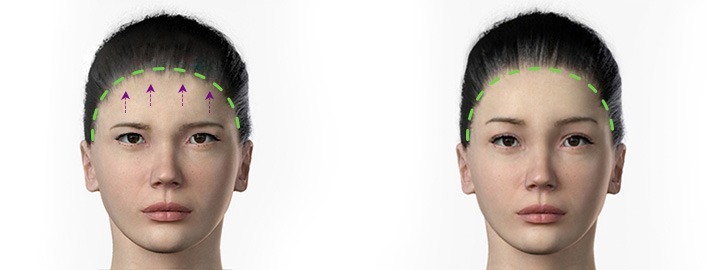
With age, the brows can drop and the forehead can develop deep horizontal lines, frown lines between the brows and crow’s feet. Low or heavy brows can make you look tired or stern, and can push extra skin down onto the upper eyelids.
A forehead lift (brow lift) raises the brows to a more natural, refreshed position and smooths lines on the forehead. Where needed, the muscles that cause frown lines are relaxed. Brow lift can be combined with a facelift or eyelid surgery, and is also part of facial feminization surgery.
Unlike Botox, which lasts a few months, surgery gives a long-lasting result, although the face continues to age naturally.
4 Brow Lift Techniques at Kamol Hospital
1. Traditional Forehead Lift / Brow Lift (Coronal Lift)
An incision is made across the top of the head behind the hairline, from ear to ear (roughly where a headband sits), so the scar is hidden in the hair. The scalp is lifted, the forehead and brows are pulled up into their new position, and excess scalp is removed. The muscles between the brows can be relaxed to soften deep frown lines and horizontal forehead lines.
Because excess scalp is removed behind the hairline, this technique also raises the hairline and lengthens the forehead. It may not suit people whose forehead is already high.
- Anesthesia and time: general anesthesia, 1–2 hours
- Hospital stay: 1 night
2. Endoscopic Forehead Lift / Brow Lift
A minimally invasive technique using four small incisions behind the hairline. An endoscope (a small camera) and fine instruments are inserted to release the tissue and muscles, smoothing forehead and frown lines and raising the brows into a more arched shape.
- Advantages: smaller scars, and less numbness of the scalp
- Limitations: a higher cost, because of the specialized equipment
- Anesthesia and time: general anesthesia, 1–2 hours
- Hospital stay: 1 night

3. Direct Brow Lift
For people with a high forehead and brows sitting very close to the eyes. An incision is made right along the upper edge of the eyebrow, excess skin is removed, and the brow is fixed in its new position. It’s a quick way to adjust brow shape and position without raising the hairline.
- Advantages: precise control of brow shape, and no change to the hairline
- Limitations: a fine scar along the upper edge of the brow

4. Temporal Lift
Targets the outer part of the brow and eye area: crow’s feet, fine lines and a flat or downward-slanting outer brow. An incision is made in the temple, about 5 cm behind the hairline above the ear. The skin and muscle over the outer third of the brow are lifted, and the new brow curve is secured with stitches.
- Anesthesia and time: local anesthesia, 1–2 hours

Who Is a Good Candidate?
- If you have deep frown lines between the brows, ptosis eyebrows, the signs of aging in the brow region
- If you have crows feet
- If you have deep frown lines across your forehead
- Physically Healthy
- Nonsmoker
Preparation
- Consult your surgeon to choose the most suitable technique and make sure you’re a good candidate.
- Have a health check to make sure no conditions affect your surgery.
- Wash your hair before surgery with an antiseptic shampoo. Don’t use hair spray or other chemical products.
- Stop aspirin, ibuprofen, herbal supplements and vitamins that affect blood clotting 2 weeks before surgery.
- Stop smoking 2 weeks before surgery.
Post-Operative Care
- Control pain with medication and cold compresses.
- Keep your head raised for 1–2 weeks to reduce swelling and protect the incisions.
- Wear the facial compression garment for 2 weeks, all the time for the first 3 days.
- Wash your hair gently 2 days after surgery to remove dried blood and prevent infection.
- Avoid salty food, which can increase swelling.
- Stitches are removed after 7 days.
- Avoid exercise for 3–4 weeks.
- Attend every follow-up appointment.
Recovery
Swelling, bruising and numbness are common in the first week, and begin to improve after about 7 days. Most patients return to work after about 1 week, and can exercise again after about 4 weeks. The result becomes clear after 2–3 months, and swelling takes at least 3 months to settle completely.
Possible Risks and Complications
Risks and complications from forehead lift or temporal brow lift are extremely rare but are as follows:
- Numbness around the incision and scalp
- Scarring
- Visible hair thinning along the incision
- Uneven brows
- Injury to the nerve that raises the brow, which may cause temporary brow drooping
- Hematoma (blood collection)
- Bleeding
- Infection
- Swelling and bruising
- Poor healing
- Side effects of anesthesia, such as nausea, vomiting or dizziness
Results
A brow lift raises the brows into a more natural, arched position, and softens frown lines and forehead creases for a fresher, more youthful look. For downward-slanting brows, a temporal lift lifts the outer brow and creates a softer curve. A traditional lift also lengthens the forehead.
Before & After Forehead Lift / Browlift / Temporal Lift


Why Choose Kamol Hospital in Bangkok for a Brow Lift
- Four techniques: Traditional, endoscopic, direct and temporal lifts, so the approach is matched to your forehead height, brow shape and goals.
- Attention to the hairline: Your surgeon considers how each technique affects your forehead length before recommending it.
- Whole upper-face planning: Brow lift can be combined with eyelid surgery, a facelift, forehead contouring or hairline lowering.
- Experience in facial feminization: Brow position is a key part of Kamol’s FFS work.
- Hospital-level safety: General anesthesia with an experienced anesthesia team, in a JCI-accredited hospital.
- Support for international patients: Multilingual coordinators and Kamol Trip help you plan your stay in Bangkok.
Frequently Asked Questions (FAQs)
Which brow lift technique is right for me?
It depends on your forehead height, how much your brows have dropped, and which areas you want to improve. A traditional or endoscopic lift treats the whole forehead and brows. A direct brow lift suits people with a high forehead, and a temporal lift targets drooping outer brows and crow’s feet. Your surgeon will recommend the best option after examining you.
Will a brow lift raise my hairline?
A traditional (coronal) lift raises the hairline, because excess scalp is removed behind it. An endoscopic lift changes the hairline very little, and direct and temporal lifts don’t affect it at all. If your forehead is already high, your surgeon may recommend a technique that avoids lengthening it, or hairline lowering, which can lift the brows while shortening the forehead.
Should I choose a brow lift or Botox?
Botox relaxes the muscles that cause frown lines and can lift the brows slightly, but the effect wears off after a few months. A brow lift physically repositions the brows and gives a long-lasting result. Botox may suit milder cases or people who aren’t ready for surgery.
Do I need a brow lift or upper eyelid surgery?
If heavy, drooping brows are pushing skin down onto your eyelids, a brow lift addresses the cause. If the brows are in a good position but you have excess eyelid skin, upper eyelid surgery may be enough. Many people benefit from both, and your surgeon will assess which is right for you.
Will I have visible scars?
Traditional, endoscopic and temporal lift scars are hidden behind the hairline. A direct brow lift leaves a fine scar along the upper edge of the brow, which usually fades well. Some people notice temporary hair thinning along the incision.
How long do brow lift results last?
A brow lift gives a long-lasting result, often many years. However, your face will continue to age naturally, so the brows may gradually drop again over time.
Can a brow lift fix hooded upper eyelids?
Sometimes, and sometimes not. Where hooding comes from a descended brow pushing tissue downward, lifting the brow helps. Where it comes from excess skin on the eyelid itself, blepharoplasty is the appropriate procedure. Many patients need both, and your surgeon will identify which is causing the appearance you want to change.
How long should I stay in Bangkok after a brow lift?
Plan to stay in Bangkok for about 7–10 days. This allows for stitch removal at 7 days and a follow-up check before you fly home. Thailand is a popular destination for facial surgery, and Kamol Trip can arrange accommodation close to the hospital.