Top surgery removes breast tissue to create a flat, masculine chest. It is one of the most common gender-affirming procedures for trans men, transmasculine and non-binary people, and for many it means no longer needing to bind.
A good result is more than just a flat chest. The aim is a natural chest contour with minimal scarring, while preserving as much sensation as possible. Most breast tissue and any excess skin are removed. The nipple and areola are usually reduced in size and repositioned to match a typical male chest. If they are already a suitable size and position, they may only need minor adjustment.
The technique your surgeon recommends depends on your breast size, how much the breasts sag, and how elastic your skin is.
Top Surgery Techniques at Kamol Hospital
We offer three techniques. Which is right for you depends on your chest size and your skin quality — not on preference alone, since skin that has lost elasticity limits what’s achievable.
1. U-Scar (Keyhole) Technique
Suitable for small breasts (around A cup) with good skin elasticity. A U-shaped incision is made along the lower edge of the areola, and breast tissue is removed through it. This leaves a flat chest with a minimal scar, and nipple sensation is usually well preserved.
- Operation time: about 1–2 hours
- Hospital stay: about 2 nights
- Stitches removed: day 7

2. O-Scar (Periareolar / Concentric) Technique
Suitable for medium breasts (around B–C cup) with good skin elasticity. An incision is made all the way around the areola. Breast tissue is removed, then a ring of excess skin around the areola is trimmed and the skin is gathered and closed around it. The chest becomes flat, and some nipple sensation is usually preserved.
- Operation time: about 2–3 hours
- Hospital stay: about 2–3 nights
- Stitches removed: day 7

3. Double Incision with Free Nipple Grafts
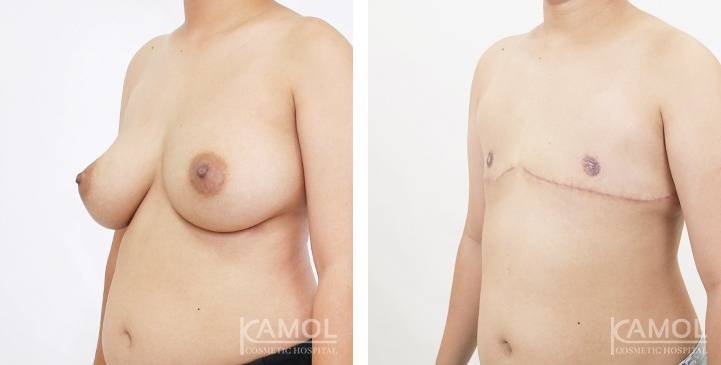
Suitable for larger or sagging breasts, or skin with limited elasticity. All breast tissue is removed, and the remaining skin is tailored to the chest through a long incision along the lower chest. The nipples are removed, reduced in size, and grafted back onto the chest in a new, masculine position. This is often the only option for larger chests, but it significantly reduces nipple sensation.
- Operation time: about 3–4 hours
- Hospital stay: about 3 nights
- Stitches removed: day 7

A note on binding
Years of chest binding commonly reduce skin elasticity. This affects the outcome and can limit which techniques are available to you, so be open with your surgeon about your binding history at consultation — it’s a normal part of the assessment, not something to be awkward about.
A Good Candidate
- Trans men, transmasculine, and non-binary people seeking a masculine chest contour
- In good general health
- Aged 18 or over
- Holding realistic expectations about scarring, sensation, and the final result
Hormone therapy and assessment. Testosterone therapy isn’t a strict requirement for top surgery, though many patients have been on it for some time before surgery. Requirements around assessment or supporting letters vary, and we’ll walk you through exactly what applies to your situation at consultation — including if you’re travelling from overseas. If you’re considering gender-affirming hormone therapy alongside surgery, we can discuss that too.
Preparation
- See a psychiatrist for assessment, and have a pre-operative health check. Kamol’s mental healthcare team can carry out the assessment in Bangkok.
- Consult your surgeon, who will assess your breast size, sagging, skin elasticity, and nipple and areola size to choose the right technique.
- Stop aspirin, anti-inflammatory drugs and herbal supplements that affect blood clotting at least 2 weeks before surgery.
- Stop smoking at least 2 weeks before surgery. Smoking reduces blood supply to the nipples and increases the risk of nipple tissue loss.
See Preparing for Gender-Affirming Surgery for the full preparation pathway.
The Procedure
- Surgery is performed under general anesthesia.
- The incision is made at the marked site, and breast tissue is removed to flatten the chest.
- Excess skin is removed to create a flat, masculine chest contour.
- The nipples and areolas are reduced in size and positioned to match a male chest.
- The incisions are closed.
Post-operative Care
- You’ll stay in hospital for 2–5 nights, depending on the technique used.
- Keep the incisions clean and dry.
- Take the pain medication and antibiotics provided as directed.
- Attend follow-up appointments at seven days, fourteen days, and every scheduled appointment thereafter.
- Stitches are removed about seven days after surgery.
- Wear the compression garment to control swelling and shape the chest, for 3–6 months as directed.
Recovery
Recovery depends on your health and the technique used. Expect discomfort for the first 2–3 days. Most patients can return to desk work within about 2 weeks, and swelling improves noticeably within 2–3 weeks. The chest continues to settle over 4–6 months. Avoid sports, heavy lifting, running and strenuous arm movements until your surgeon advises it is safe.
Risks and Complications
After surgery, risk and complexity are possible as follows;
- Bleeding is a risk of any operation, but the need for transfusion is rare. However, specialized surgeons are well concerned and will always keep control to stop bleeding during surgery.
- Infections are infrequent complications.
- Nipple necrosis. The blood supply of the nipple might be damaged with more limited operation and nipple necrosis. If the nipples are used as grafts, the nipple graft does not take well. These complications are exceedingly rare.
- Loss of nipple sensation, numbness
- Loss of nipple and areolar
- Poor healing
- Swelling after surgery
- Painful will occur but can take a painkiller
- The scars of the areola usually heal very well. As mentioned above, the scars below the breast will take longer to fade out and will widen. However, a raised or extensive scar is possible and might need further treatment. There may be residual tissue left, which appears as a contour deformity. This scar needs to be removed at a second stage.
- Risk from anesthesia
Before and After Top Surgery, Mastectomy
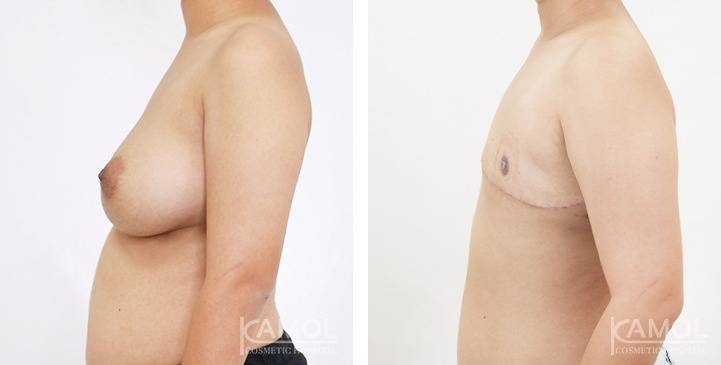
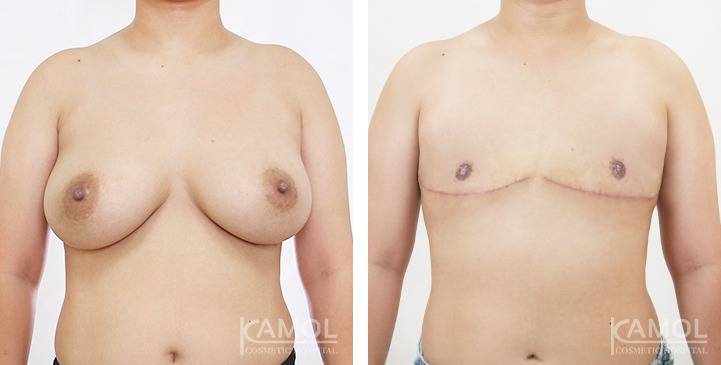
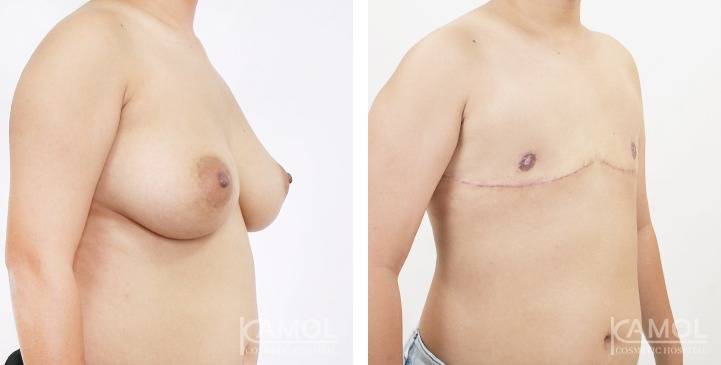
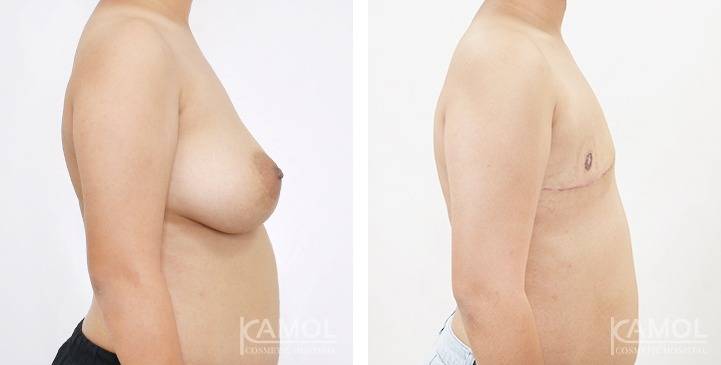
Video : Testimonials of Female to Male Mastectomy (Top Surgery)
Why Choose Kamol Hospital in Bangkok for Top Surgery
- Experience with trans patients from around the world: Gender-affirming surgery is central to Kamol’s work, and our plastic surgeons perform top surgery routinely.
- A technique matched to your chest: U-scar, O-scar and double-incision techniques are all available, chosen according to your breast size, skin elasticity and goals.
- Attention to the details that matter: A flat contour with no excess skin under the arms, careful scar placement, and nipples reshaped and positioned to suit a male chest.
- Care for the whole transition: Psychiatric assessment, gender-affirming hormone therapy, and other female-to-male procedures, such as hysterectomy and facial masculinization, all under one roof.
- Hospital-level safety: Surgery under general anesthesia, inpatient monitoring for 2–5 nights, and accreditation from Joint Commission International (JCI).
- Support for international patients: Multilingual coordinators and Kamol Trip help you plan your stay and recovery in Bangkok.
Frequently Asked Questions (FAQs)
What is a female-to-male (FTM) mastectomy, also known as "top surgery"?
Top surgery is a surgical procedure that removes breast tissue and creates a more masculine chest contour. It is a common procedure for trans men, transmasculine individuals, and some non-binary people as part of their gender transition.
What are the different types of FTM top surgery techniques available at Kamol Cosmetic Hospital in Bangkok, Thailand?
At Kamol Cosmetic Hospital, our expert surgeons are experienced in a variety of top surgery techniques, including:
- Double Incision with free nipple grafts: This technique is suitable for most patients and involves removing excess skin and breast tissue through two incisions. The nipples are then grafted back onto the chest.
- Periareolar: This technique is ideal for patients with smaller chests and involves making an incision around the areola. Excess tissue is removed, and the nipple is repositioned.
- Keyhole: This technique is suitable for patients with minimal excess skin and involves making a small incision below the nipple. This technique may be combined with liposuction.
Your surgeon will discuss the most suitable technique for you based on your individual anatomy, desired outcome, and medical history.
What are the benefits of undergoing top surgery at Kamol Cosmetic Hospital in Bangkok, Thailand?
Choosing Kamol Cosmetic Hospital for your top surgery offers numerous noteworthy benefits:
- Expertise: Our surgeons are highly skilled and experienced in performing, double incision, keyhole, and periareolar mastectomy with excellent results.
- World-class facilities: Our hospital is equipped with the latest technology and adheres to the highest international safety and hygiene standards.
- Comprehensive care: We provide personalized care and support throughout your surgical journey, from your initial consultation, through to your post-operative recovery.
- Affordable cost: mastectomy at Kamol Cosmetic Hospital in Bangkok, Thailand is competitively priced, making it a more affordable option compared to many other countries.
- Destination: Bangkok is a vibrant city with plenty to offer, making your surgical trip a memorable experience.
Do I need to be on testosterone or have a psychiatric letter before top surgery?
Testosterone is not usually required for top surgery, and many patients have chest surgery before or without starting hormones. A mental health assessment confirming gender dysphoria is required before surgery. If you don’t have a letter yet, our psychiatrists can complete the assessment in Bangkok.
Will I keep nipple sensation?
It depends on the technique. With U-scar and O-scar techniques, the nipple stays attached to its nerves and blood supply, so sensation is often partly or fully preserved. With double incision and free nipple grafts, the nipple is fully detached, so sensation is significantly reduced and may not return. Your surgeon will explain what to expect for the technique recommended for you.
Should I stop binding before surgery?
You can usually keep binding until surgery, but giving your skin regular breaks helps protect its elasticity and skin health. Avoid binding over broken or irritated skin, and tell your surgeon how long and how often you’ve been binding, as it can affect the technique choice.
How visible will the scars be?
U-scar and O-scar techniques leave scars around the areola that usually blend in well. Double incision leaves two horizontal scars along the lower chest, which are often placed along the natural line of the pectoral muscle. Scars are red at first and fade gradually over 12–18 months. If you’re prone to raised scars, early scar care and treatments such as keloid removal can help.
When can I return to the gym?
Light walking is encouraged from the first days. Avoid lifting your arms above shoulder height, heavy lifting and upper-body workouts for several weeks, as this can strain the incisions. Most patients return to full chest and arm training after about 6 weeks, once their surgeon confirms healing is complete.
Should I stop binding before surgery?
You can usually keep binding until surgery, but giving your skin regular breaks helps protect its elasticity and skin health. Avoid binding over broken or irritated skin, and tell your surgeon how long and how often you’ve been binding, as it can affect the technique choice.
How long should I stay in Bangkok after top surgery?
Plan to stay in Bangkok for about 2 weeks. This covers your hospital stay (2–5 nights depending on technique), stitch removal on day 7, and the follow-up check on day 14 before you fly home. Thailand is one of the world’s most established destinations for gender-affirming surgery, and Kamol Trip can arrange accommodation close to the hospital.